
Just when we thought we had seen it all, the Hubble Space Telescope has delivered yet another stunning cosmic masterpiece. Astronomers have imaged the largest protoplanetary disk discovered to date a massive, dust-filled nursery for baby planets located about 1,000 light-years away. Nicknamed “Dracula’s Chivito,” this colossal structure is not only breaking records for its size but also offering unprecedented clues into how solar systems like our own come to be.
Officially cataloged as IRAS 23077+6707, this protoplanetary disk is a true giant. Spanning approximately 400 billion miles (about 643 billion kilometers), it is roughly 40 times the diameter of our entire Solar System. To put that in perspective, if our Sun were at the center, this disk would extend far beyond the orbit of Neptune and the Kuiper Belt, dwarfing everything in its local vicinity.
The disk was captured “edge-on” from Earth’s perspective, giving it a distinctive appearance that astronomers have likened to a “cosmic hamburger” or, more specifically, a “chivito” (a famous Uruguayan sandwich). The central dark band is the dense dust and gas where planets are likely forming, blocking the light from the young star inside. The glowing regions above and below are starlight scattering off the disk’s outer layers.
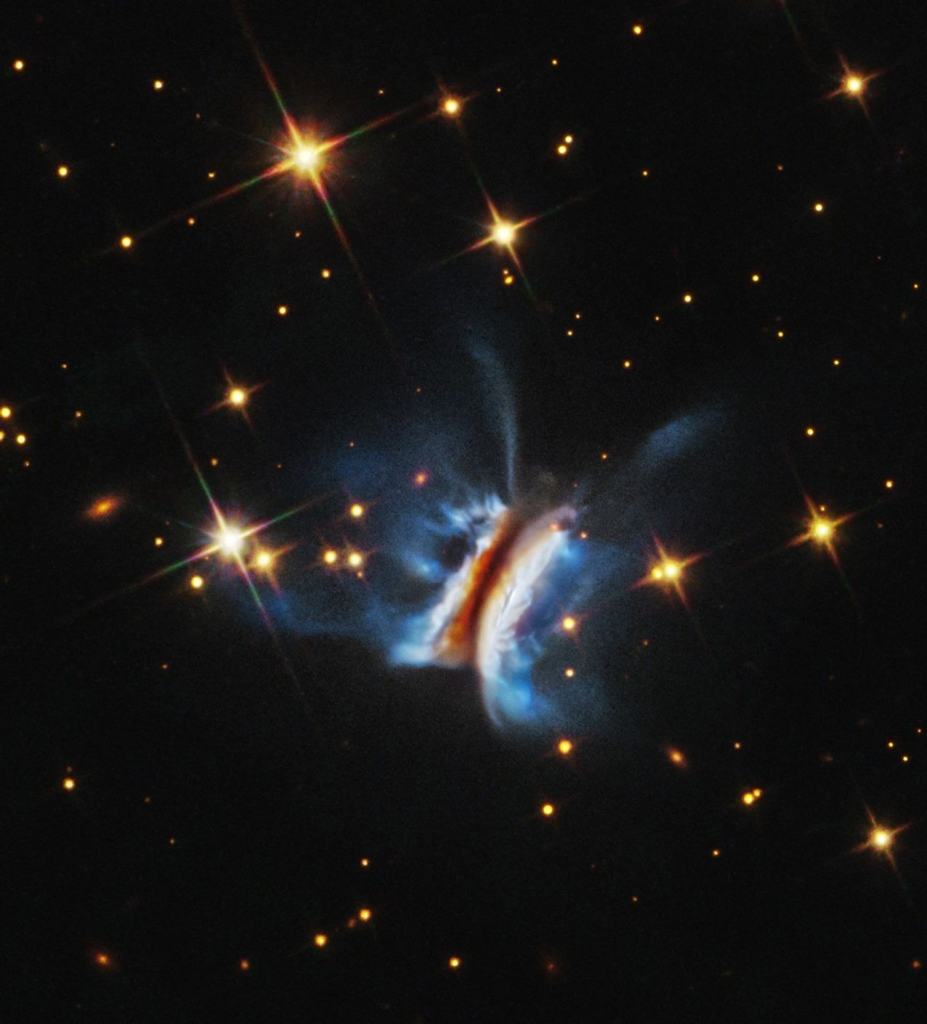
But why the name “Dracula’s Chivito”? It’s a nod to the international team that discovered it. The nickname playfully combines “Dracula,” referencing the lead author’s Transylvanian roots, with “Chivito,” the national dish of Uruguay, the home country of another key researcher.
“This disk is so massive and rich in material that it could potentially birth multiple gas giants,” said the research team in a statement released by NASA and ESA. The discovery provides a rare, detailed look at the chaotic environment where worlds are born, helping scientists refine their models of planetary formation.
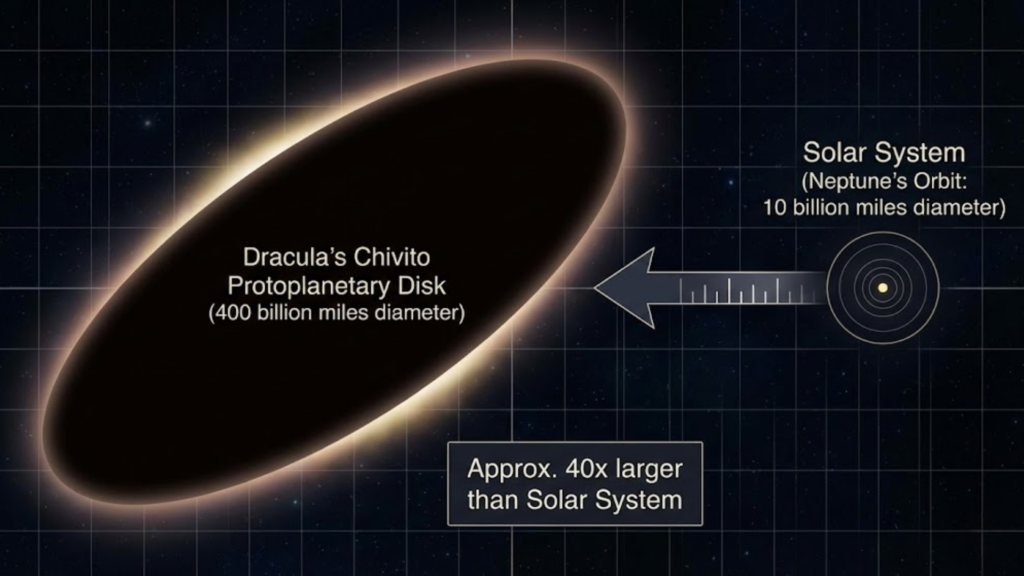
Decades after its launch, Hubble continues to prove it is an invaluable tool for astronomy. “Dracula’s Chivito” is more than just a funny name; it is a window into our own past, showing us the raw materials and massive scales involved in the creation of a solar system. As we continue to study this “cosmic sandwich,” who knows what other secrets about the origins of life and planets are waiting to be revealed?
Link: https://esahubble.org/images/opo2606/
Discover “Dracula’s Chivito,” the largest protoplanetary disk ever imaged by Hubble. Learn about this massive “cosmic hamburger” and what it reveals about planet formation, with exclusive images and a size comparison.
Hubble Space Telescope, Dracula’s Chivito, IRAS 23077+6707, protoplanetary disk, astronomy news, NASA, ESA, planet formation, space discoveries 2025.